

Consumption is the anchor, but investment drives the cycle
Raymond James Chief Economist Eugenio J. Alemán discusses current economic conditions.
We often hear that consumption accounts for roughly 70% of the US economy and that, as long as consumers keep spending, the economy will continue to grow. There is certainly some truth to that. Consumption is not only the largest component of GDP but also one of its most stable. However, focusing exclusively on consumption misses an important part of what drives the business cycle: investment.
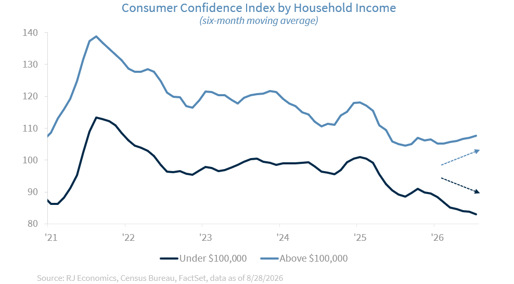
This distinction is particularly important today because the K-shaped economy is extending beyond consumers and into corporate America. Higher-income households continue to account for an outsized share of spending, supported by strong balance sheets, rising asset values and accumulated wealth.
This week’s Consumer Confidence report reinforced that divergence: Confidence improved among higher-income households, while it continued to deteriorate across every income group earning less than $75,000, as shown in the chart below. The result is an increasingly pronounced confidence gap across the income distribution.
At the same time, corporate investment has become increasingly concentrated among large companies, particularly those investing heavily in artificial intelligence. Reflecting this strength, nonresidential equipment investment has increased at an annualized pace of more than 15% in each of the last two quarters, while investment in intellectual property products has risen 8.8% and 13.8%, respectively.
If we can borrow a family analogy, consumption is the dependable member of the economic family. It pays the bills, keeps things moving and generally does not change its behavior dramatically from one day to the next. Like any family, however, the economy has members with very different personalities and roles. Investment is the adventurous one.
Importantly, “investment” in economics does not mean buying equities or bonds, as the term is commonly used by investors. Economic investment refers to expenditures that expand the economy’s capacity to produce goods and services such as factories, equipment, technology, software, intellectual property, housing and other productive assets.Continuing our family analogy, investment is the economy’s “problem child,” and we mean that in the best possible way. It is innovative, creative, risk-taking, volatile and sometimes unpredictable. It responds aggressively to both positive and negative incentives and can move from euphoria to caution (or even contraction) very quickly. Although investment represents a much smaller share of GDP than consumption, its volatility gives it an outsized influence over the business cycle.
John Maynard Keynes famously associated these swings with “animal spirits,”1 the shifts in confidence and expectations that can cause businesses to enthusiastically invest during good times and abruptly pull back when uncertainty rises.
The accompanying graph illustrates this distinction clearly. With the notable exception of the COVID-19 pandemic, consumption typically declines relatively modestly during recessions. Gross private domestic investment, however, displays much stronger “animal spirits,” both on the way down and on the way back up. When confidence deteriorates, businesses become more risk averse, investment falls, hiring slows, layoffs increase and the weakness can spread throughout the economy.
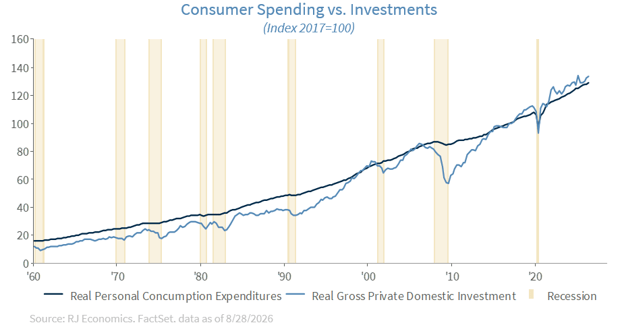
The catalyst differs from cycle to cycle. In the early 2000s, it was the bursting of the dot-com bubble. During the 2007–2009 global financial crisis, the collapse in housing and residential investment played a central role. That history helps explain why so much attention is being paid today to whether the enormous AI investment cycle can continue. We have discussed this risk previously, as well as the growing competition for capital created by AI investment.
For now, we are somewhat more concerned about the consumer than about the AI investment cycle. Employment and income growth have slowed, contributing to the increasingly visible K-shaped economy. But that weakness remains concentrated primarily among lower- and middle-income households, which have had greater difficulty keeping pace with the cumulative increase in prices. Higher-income households, meanwhile, have remained considerably more resilient.
The greater risk would be if both sides of the “K” weakened at the same time
If the AI investment and equity-market boom were to falter, the consequences could extend well beyond business investment. A significant equity market decline could weaken the wealth and confidence that have helped higher-income households sustain their spending. At the same time, weaker AI-related capital expenditures could weigh directly on business investment, employment and economic growth. In other words, an investment downturn could remove an important source of growth precisely when lower- and middle-income consumers are already under pressure.
That is not our base case. We continue to expect the US economy to expand at a healthy pace, with real GDP growth of approximately 2.3% this year. We expect growth to decelerate modestly next year but remain around, if not above, the economy’s potential growth rate, supported in part by an expected pickup in productivity.
The takeaway is straightforward: Consumption may be the economy’s stabilizer, but investment is often its accelerator and its brake. Today, both remain supportive enough to keep the expansion moving forward. But with economic growth increasingly dependent on higher-income consumers and investment increasingly tied to the AI cycle, keeping an eye on both sides of that equation will be critical to determining whether the expansion still has room to run.
1Animal spirits refers to “the instinctive, emotional, and non-rational factors – such as confidence, hope, fear, and spontaneous optimism – that drive human financial decisions and business investments under conditions of deep uncertainty, rather than purely mathematical or rational calculations.” Source: tutor2u
Economic and market conditions are subject to change.
Opinions are those of Investment Strategy and not necessarily those of Raymond James and are subject to change without notice. The information has been obtained from sources considered to be reliable, but we do not guarantee that the foregoing material is accurate or complete. There is no assurance any of the trends mentioned will continue or forecasts will occur. Past performance may not be indicative of future results.